

The Agentic Brain
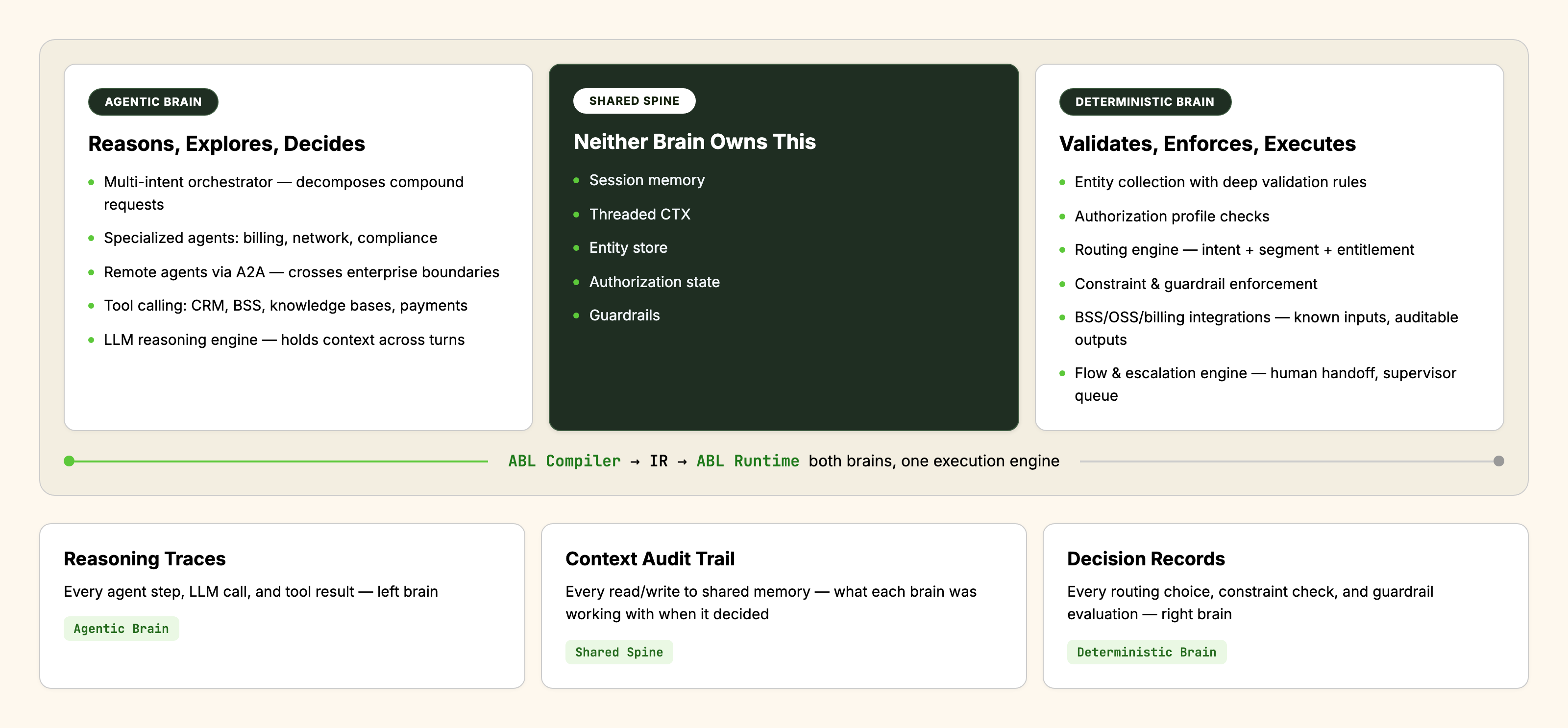
The Agentic Brain reasons, explores, and decides. It handles the open-ended parts of an interaction where the correct path is not known in advance. The Agentic Brain runs:- A multi-intent orchestrator that decomposes compound user requests into separate intents.
- Specialist agents scoped to domains such as billing, network operations, or compliance.
- Remote agents reached via the A2A protocol, including agents hosted outside the platform.
- Tool calls against CRM systems, BSS platforms, knowledge bases, and payment systems.
- An LLM reasoning engine that holds context across turns.
The Deterministic Brain
The Deterministic Brain validates, enforces, and executes. It handles the parts of an interaction where the path must be predictable, auditable, and policy-compliant. The Deterministic Brain runs:- Entity collection with deep validation rules.
- Authorization profile checks against the requesting user.
- A routing engine that combines intent, customer segment, and entitlement.
- Constraint and guardrail enforcement on both inputs and outputs.
- BSS, OSS, and billing integrations with known inputs and auditable outputs.
- A flow-and-escalation engine for human handoff and supervisor queues.
The Shared Spine
The Shared Spine is the runtime coordination layer. Neither brain owns it. Both brains read from and write to it, and neither can act without going through it. The Shared Spine holds:- Session memory.
- Threaded conversation context.
- The entity store.
- Authentication state.
- Active guardrails.
Compilation and execution
Agent definitions move through three stages before they execute. Both brains share the same compiler, the same IR format, and the same runtime.
Because both brains compile from the same ABL definition to the same IR, there is no drift between the authored agent intent and the deployed behavior. Compile-time validation catches errors before they reach any downstream environment.
Observability outputs
The runtime emits three categories of structured trace data. Together, they make every agent decision reconstructable after the fact.
These trace categories are complementary. Reasoning Traces answer what the agent did. Decision Records answer what rules were applied. The Context Audit Trail answers what data each brain had access to. All three are required for full session reconstruction.
Why the split matters
A single-engine design forces a trade-off: either the agent reasons flexibly and sacrifices auditability, or it follows a fixed deterministic path and loses the ability to handle open-ended input. The dual-brain model avoids this trade-off by separating the concerns while keeping both engines under one governance layer.
Because both brains are defined in ABL and compiled to the same IR, the runtime can enforce guardrails uniformly across both execution paths. There is no policy gap between the agentic and deterministic sides of an interaction.