

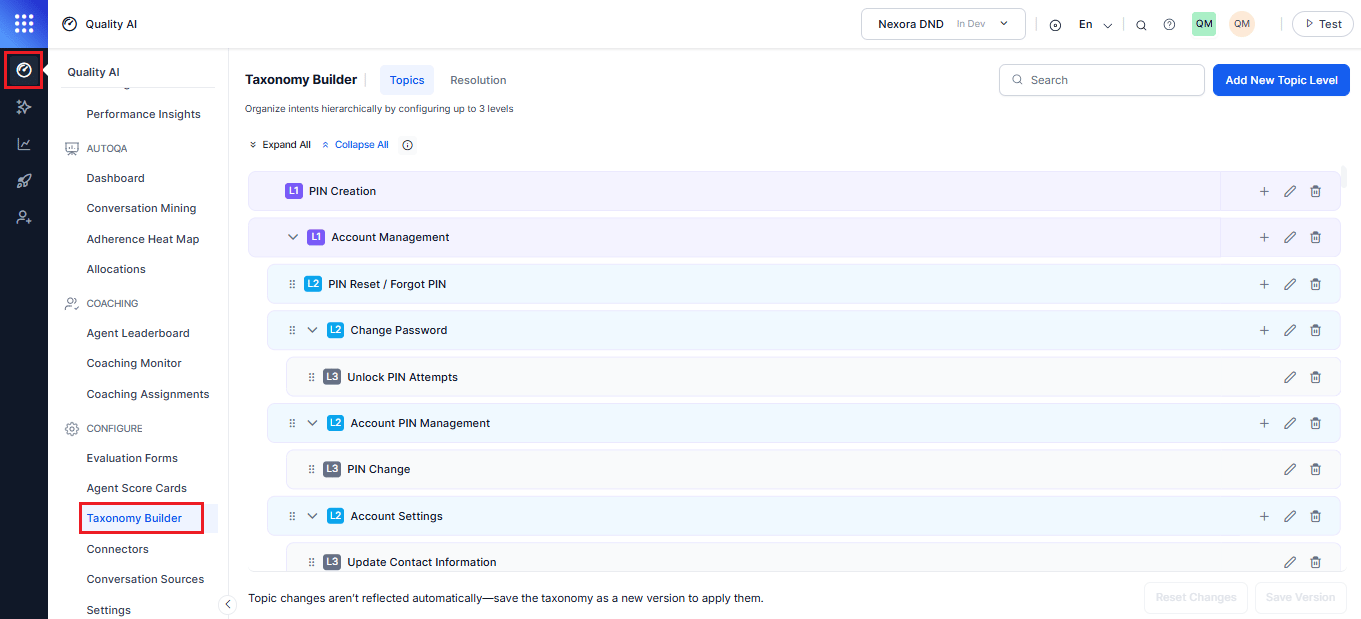
Why Taxonomy Builder?
Traditional conversation analytics face challenges that affect day-to-day operations:
Taxonomy Builder solves these problems by enabling you to:
- Define custom topic hierarchies that mirror your business structure.
- Ensure consistent labeling across all conversations.
- Analyze topics at strategic (L1), tactical (L2/Standalone L2), and operational (L3) levels.
- Track resolution rates and sentiment for specific customer contact reasons.
- Visualize topic performance through color-coded indicators.
Three-Level Hierarchy
Advanced Features
Visual Hierarchy
The interface uses color-coded levels and progressive indentation to distinguish L1, L2, and L3 topics, making the structure visible at a glance.Interactive Guidance
Hover over the information icon (ⓘ) to view:- Allowed topic movements between hierarchy levels
- Restricted operations that preserve taxonomy integrity
- Parent-child relationship rules
- Impact of restructuring on the hierarchy
Contextual Parent Assignment
When you add topics from existing nodes, the system preselects the correct parent context automatically, streamlining topic creation.Intelligent Topic Detection
The system uses large language models (LLMs) with custom topic names and detailed descriptions to classify conversations accurately. Write clear descriptions to help the model identify which customer statements belong to each topic.Topic-Level Resolution (L3)
For Level 3 topics, enable resolution tracking to determine whether the system resolves each customer issue during the conversation. The system classifies each issue as Successful, Unsuccessful, or Overall Resolution, using customizable criteria per topic.Resolution Methods
Topic-Based Resolution (Strict):- Mark a contact as resolved only when the system resolves all L3 topics in the conversation.
- Use this when the system must resolve all issues, including minor ones.
- Example: A customer calls about a payment issue and mentions a rewards question. If the system resolves the payment issue but not the rewards question, it marks the contact as unresolved.
- LLM evaluates contact resolution independently of individual topic outcomes.
- Marks a contact as resolved when it addresses the customer’s primary concern, even if minor issues remain.
- Use when you don’t want secondary issues to affect the resolution metrics.
- Example: The system resolves the customer’s payment issue, but not a casual rewards question; it still marks the contact as resolved.
Hierarchical Sentiment Analysis
The system captures customer sentiment at the L3 level and automatically rolls it up through the hierarchy. The Topic Discovery dashboard shows color-coded sentiment bubbles:Flexible Structure
Not all organizations need a full three-level hierarchy. You can create standalone L2 topics with L3 subtopics when your business doesn’t require an L1 strategic layer.System Architecture
Version Management
All taxonomy changes exist as drafts until you explicitly create and deploy a new version. This prevents accidental disruptions to ongoing analysis and gives you full control over when changes take effect.Security and Permissions
The system tracks all changes through audit logs and changelogs.
Business Impact
A taxonomy aligned with your organizational reality turns every conversation into a precise data point for decision-making:- Quality Teams — deliver targeted coaching based on specific interaction types.
- Operations Managers — identify emerging issues early and respond at the right level of detail.
- Customer Experience Leaders — track sentiment trends at the touch points that matter most.