

- Tier 1 (App-level): controls whether the call is answered at all, based on bot readiness.
- Tier 2 (Flow-level): monitors bot responsiveness after the call is established.
- Tier 3 (Node-level): handles errors at individual nodes within the conversation flow.
Configure Tier 1 Answer Call on Bot Response
TheAnswer Call on Bot Response flag determines when the platform sends a SIP 200 OK to accept an incoming call. When you enable this flag, the platform delays answering until the bot’s first response is ready. If the bot is unreachable, the call is never answered, and the upstream SIP system receives a standard error code to trigger its own fallback routing.
To configure this setting, go to App Settings > Advanced Settings > System Settings.
By default, the flag is disabled. The call is answered immediately, and the bot prepares its first response after the call connects — which can result in the caller hearing dead air. When you enable the flag, no dead air occurs, but the call depends on the bot being ready within the SIP timeout window.
Use this setting when:
- Your telephony infrastructure requires SIP error codes to trigger fallback routing.
- Upstream systems such as an IVR, SBC, or carrier need to reroute calls based on SIP failures.
- Your deployment has strict call quality SLAs that require zero dead air.
Configure Tier 2 Bot No Input
TheBot No Input setting monitors bot responsiveness after the first response has been delivered. If the bot doesn’t respond within the configured timeout, the system automatically triggers the fallback action you have configured.
To configure this setting, go to Contact Center AI > Start Flows > Create or edit a Start Flow > Bot No Input.
The following parameters are available:
The following fallback actions are available:
- End Call — Terminates the call automatically when bot unresponsiveness is detected.
- SIP URI Transfer — Transfers the call to a specified SIP URI, such as a live agent queue, backup IVR, or emergency line.
- Play Message + Retry — Plays a holding message while waiting for the bot to recover. If the give-up timeout is reached, the configured End Call or SIP Transfer action executes.
This setting only activates after the bot has delivered its first response. If the bot never responds at all, use Tier 1 (Answer Call on Bot Response) to handle that scenario.
Configure Tier 3 OnError Path
TheOnError path lets you define a custom recovery workflow for each type of error that can occur at individual nodes in your Experience Flow. You can configure a different response for ASR errors, TTS errors, dialog failures, and backend processing errors.
To configure OnError paths, go to Contact Center AI > Start Flows > Automation Node > Error Handling tab.
The following error types are supported:
Understand Configuration Priority
Before you deploy, decide which settings to enable and in which order to configure them.Plan for Deployment Scenarios
Enterprise SIP-integrated Environment
Use this configuration for large enterprises with SIP-aware telephony infrastructure such as Avaya, Cisco, or Genesys.
With this configuration, the call is answered only when the bot is ready, SIP error codes are available to upstream systems, an unresponsive bot triggers a transfer to the fallback SIP target, and specific errors are handled with tailored recovery workflows.
Direct or Simple Call Environment
Use this configuration for smaller deployments or consumer-facing bots with direct SIP trunks.
With this configuration, calls are answered immediately, bot silence results in call termination, and standard error messages handle common failures.
High-availability or Mission-critical Environments
Use this configuration for healthcare hotlines, emergency services, or financial institutions where call continuity is essential.
With this configuration, every layer provides a fallback, ASR/TTS redundancy is active, and SBC failover protects against infrastructure-level failures.
Handle SIP Failures
During Call Establishment
If the system encounters an issue during SIP connection setup, it sends the appropriate SIP error code to the client system. Configure your telephony infrastructure to respond to each code.During Agent Transfers
When the system sends aSIP INVITE or SIP REFER to a recipient system during an agent transfer, the recipient may return an error code if it can’t accept the call.
To handle transfer failures, configure the Error Path on the Agent Transfer node to do one of the following:
- Play a message informing the caller of the issue.
- Redirect the caller to a different node or agent queue.
- Retry the transfer after a brief delay.
- End the call with an appropriate message.
Handle AI for Service Downtime
Before Call Establishment
If the platform is unreachable when a call arrives, enable Answer Call on Bot Response. The call isn’t answered, and the upstream SIP system receives an error code to route the caller to an alternative destination such as a live agent queue or backup IVR.During an Active Call
If the system becomes unavailable mid-call, the Bot No Input setting detects the bot’s silence and triggers the configured fallback action — End Call, SIP URI Transfer, or Play Message + Retry. The following table explains how all three tiers protect the call at each stage:Configure ASR and TTS Failover
The system supports configuring multiple ASR and TTS vendors so that if a primary vendor fails, the system switches to a secondary automatically.- Configure a primary and a fallback vendor for both ASR and TTS independently.
- Use a different region for the fallback vendor to protect against regional outages.
- If both primary and fallback providers fail, the system transfers the call to a live agent via SIP
REFER.
Configure Voice Gateway Infrastructure Resiliency
The Voice Gateway includes two Session Border Controllers (SBCs) for redundancy. An SBC manages incoming and outgoing SIP connections at the network edge.- The primary SBC handles all connections under normal operation.
- The secondary SBC activates when the primary SBC fails.
- Failures are signaled to the customer’s SBC via
4xxSIP error codes.
Voice Gateway Component Failure Handling
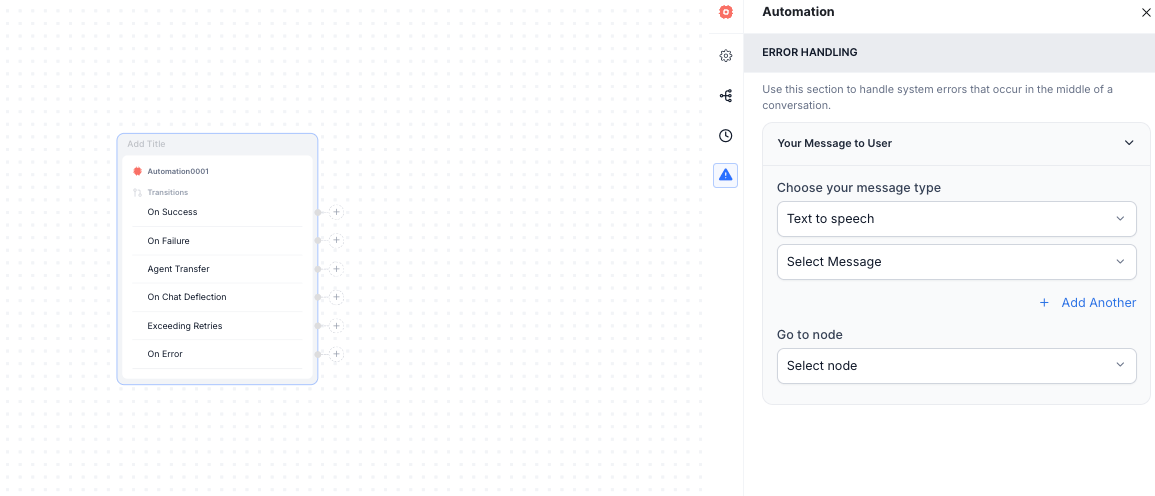
Voice Gateway components such as FreeSWITCH, ASR, and TTS can crash or restart under high traffic or memory exhaustion. These failures interrupt active calls and leave callers on dead air if the existing session cannot continue. The system routes new calls to the restarted component or to another available redundant component. This section explains how to configure fallback options — playing a message, transferring the call, or ending it gracefully — so that callers receive feedback instead of dead air. To configure error handling and define how Voice Gateway responds when a component failure affects an active call, follow these steps:- Open Error Handling in the Automation Node.
-
To end a call gracefully, configure a message that the system plays to the caller before it disconnects the call.
Handle Routing and System Errors
A DID (Direct Inward Dialing) number must be correctly mapped to a Start Flow. If the mapping is missing or the flow fails to trigger, the call has no destination. To configure system error handling, go to Flows & Channels > Voice Gateway > Voice Preferences > System Error Settings. Routing errors occur when:- The DID number isn’t attached to any Start Flow.
- The Start Flow mapped to the DID number fails to trigger due to a configuration error or disabled flow.
REFER to transfer the caller to a different number.
Implementation Checklist
Tier 1 App-level
- Decide whether to enable
Answer Call on Bot Responsebased on your SIP integration requirements. - If you enable the flag, confirm your opening dialog flow contains no heavy service calls before the first greeting.
- Confirm your upstream SIP system is configured to handle SIP error codes from the platform.
Tier 2 Flow-level
- Set the
Bot No Inputtimeout value based on your expected bot response times in production. - Select a fallback action —
End Call,SIP Transfer, orPlay Message + Retry— and configure the required parameters. - Test the timeout by simulating a non-responsive bot and verifying the fallback action triggers correctly.
Tier 3 Node-level
- Configure
OnErrorpaths on every Automation Node for ASR, TTS, Dialog Flow, and Bot error types. - Set a default error path on each node that transfers to a live agent for any unhandled error.
- Test each error path by simulating the relevant failure type.
ASR or TTS resilience
- Configure primary and fallback ASR vendors using different regions or vendors.
- Configure primary and fallback TTS vendors independently from ASR.
- Test vendor failover by simulating a primary vendor outage.
Infrastructure
- Confirm the customer’s SBC is configured with both the primary and secondary SBC addresses.
- Verify all DID numbers are correctly mapped to Start Flows before go-live.
- Test SBC failover by simulating primary SBC unavailability.
Best Practices
- Configure all three tiers before go-live. Each tier catches a different class of failure; removing one creates a gap.
- Set every error path to transfer to a live agent by default. Never leave a caller at a dead end.
- Keep your opening dialog flow lightweight. The first bot response should be a simple greeting with no backend dependencies.
- Test failure scenarios regularly. Simulate each failure type in staging — don’t rely on happy-path testing only.
- Monitor and adjust timeout values after go-live. Production bot response times often differ from test environments.
- Use configurable parameters for SIP transfer targets. Hard-coded targets require redeployment to change.
- Plan for total platform unavailability. Always have a fallback that doesn’t depend on the platform being available.